

 See My Latest Article on HelloNation
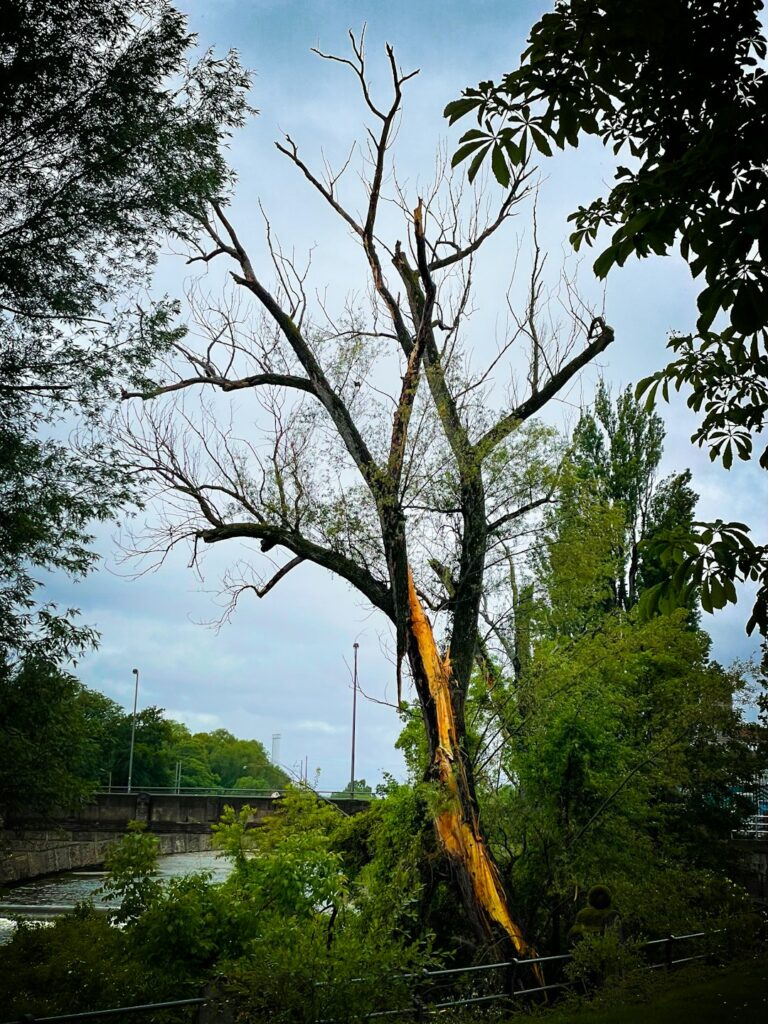
A lightning strike can leave a tree looking nearly normal while causing serious internal damage. After a storm, the safest approach is to protect people first, stay away from electrical hazards, and inspect the tree only from a distance until the area is safe.
What should you do immediately after lightning strikes a tree?
Stay indoors until at least 30 minutes have passed since the last thunder. Lightning can remain a danger even after heavy rain has stopped, and a tree may have unstable limbs or hidden structural damage.
Once conditions are safe:
- Keep children, pets, and visitors away from the tree.
- Do not stand beneath its branches, even if the canopy appears intact.
- Look for downed wires, arcing, smoke, fire, split limbs, or branches resting on structures.
- Avoid touching the tree, fence, metal objects, or anything in contact with a power line.
- Keep vehicles and lawn equipment away from the area.
If there is smoke or fire, move away and call emergency services. Do not attempt to extinguish a fire in a tree if electrical equipment or wires may be involved.
Can a lightning-struck tree still be dangerous if it is standing?
Yes. A tree does not need to fall immediately to present a hazard. Lightning may split the trunk, loosen major limbs, damage roots, or weaken branch connections. Some failures occur later, especially after wind, rain, or the freeze-thaw cycles common in Rochester.
Warning signs include:
- Long strips of missing bark
- A vertical crack or opening in the trunk
- Freshly exposed wood
- Hanging or broken branches
- A new lean
- Soil lifting or cracking around the roots
- Mushrooms or unusual moisture near the base
- A crown that suddenly droops or appears uneven
- Large branches resting against other limbs or structures
A lightning channel may travel down the outside of the trunk, through the wood, or along the tree’s moist tissues. Damage can be limited to one section, or it can extend from the crown to the roots. The absence of a dramatic bark explosion does not prove that the tree is safe.
What if the tree is near power lines?
Treat the tree as an electrical hazard. Do not approach, prune, climb, move branches, or use a ladder near it. A branch touching a line can be energized, and power lines may not visibly spark or make noise.
Stay well away from any downed or sagging line and keep others from entering the area. Do not assume a line is harmless because the power is out; some lines may become energized again without warning. Report the electrical hazard to the local utility through its emergency reporting process.
Tree work around energized conductors requires specialized training, equipment, and coordination with the utility. Ordinary work gloves, rubber boots, ladders, and household tools do not make this situation safe.
Should you cut off damaged branches yourself?
Usually not if the damage is high in the tree, involves a large limb, or affects the trunk. Lightning damage often creates overhead hazards that are difficult to judge from the ground. Cutting one branch can also change the weight distribution and cause another weakened limb to fail.
Do not climb a lightning-struck tree. Do not use a chainsaw while standing on a ladder, on a roof, or beneath suspended branches. Storm-damaged wood can behave unpredictably, and tension in a broken limb may cause it to move suddenly when cut.
Small branches that have clearly fallen to the ground and are far from wires may be moved only after the storm has fully passed and the surrounding tree has been assessed from a safe distance. If the tree is leaning, split, uprooted, or close to a home, garage, sidewalk, road, or utility line, keep clear.
How can you tell whether the tree may recover?
Some lightning-struck trees survive, but recovery depends on the extent and location of the damage. A strike that affects only a narrow strip of bark may be less serious than one that splits the trunk or destroys major roots. Tree species, age, prior health, soil conditions, and the amount of canopy lost also matter.
A tree may show delayed symptoms over the following weeks or months, including:
- Browning or wilting leaves
- Branch dieback
- New cracks
- Peeling bark
- Insect activity around damaged wood
- Fungal growth
- Poor leaf development the following season

Do not seal cracks with paint, tar, or household materials. Such coatings can trap moisture and make it more difficult to monitor the wound. Avoid heavy pruning simply to make the tree look better; removing too much live wood can add stress.
A qualified tree-risk assessment is appropriate when the tree is near a building, public path, driveway, play area, or utility line, or when the trunk or root system appears damaged. The assessment should focus on whether the tree or particular limbs are likely to fail, not merely whether the tree was struck.
What should Rochester residents check after a storm?
Storm conditions in the area can combine lightning damage with saturated soil, strong wind, and heavy rain. In older neighborhoods, trees may also be close to homes, garages, sidewalks, overhead utilities, and narrow property lines. These factors can increase the consequences of a later limb or tree failure.
After the weather clears, inspect the wider property from a safe location:
- Check whether branches have landed on roofs, gutters, fences, or vehicles.
- Look for new movement in the trunk or exposed roots.
- Note whether the tree is blocking a driveway, sidewalk, or public roadway.
- Watch for broken branches caught high in the canopy.
- Check for damage to nearby trees that may have been struck indirectly or pushed by wind.
- Keep people away from areas where branches are suspended overhead.
Photographs taken from the ground can help document damage for household records or insurance discussions. Do not place yourself under the canopy to obtain a closer view.
Is lightning likely to strike the same tree again?
Yes. A tree is not protected from another strike after being hit once. Tall, isolated, or prominent trees can be struck repeatedly during the same storm or during a later storm. Lightning can also travel from a nearby strike through the ground or through connected branches and roots, damaging trees that were not hit directly.
For personal safety, never shelter under a tree during a thunderstorm. Move into a substantial enclosed building or a fully enclosed hard-topped vehicle as soon as possible. Outdoor activity should wait until 30 minutes after the last thunder.
When is urgent action needed?
Treat the situation as urgent if the tree:
- Has fallen onto a house, vehicle, road, or utility line
- Is burning, smoking, or producing sparks
- Has a large split extending through the trunk
- Is leaning noticeably after the storm
- Has lifted roots or unstable soil around its base
- Contains large broken limbs suspended over an occupied area
- Blocks access for emergency vehicles or creates an immediate public hazard
In these cases, leave the area and report the hazard through the appropriate emergency, utility, or municipal channel. Keep people away until the electrical and structural risks have been addressed.