

 See My Latest Article on HelloNation
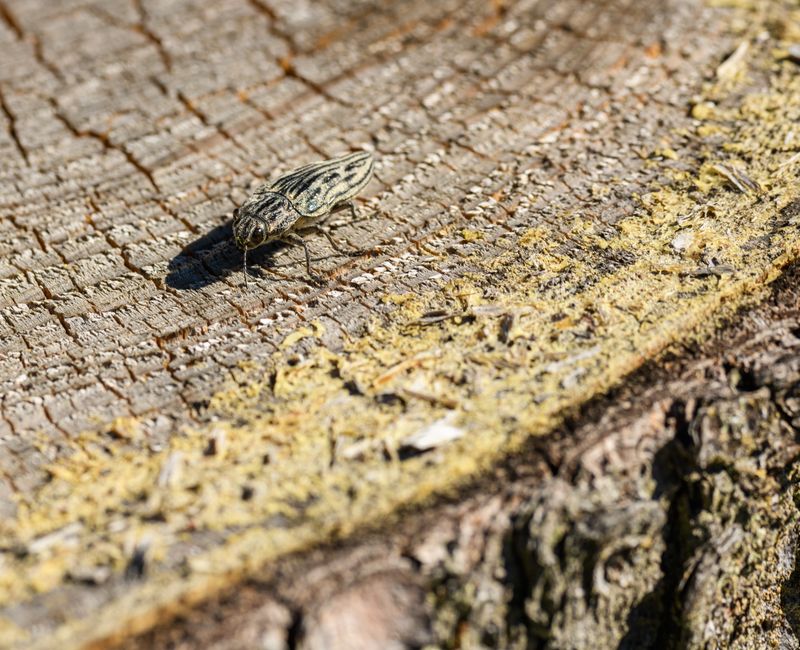
Rochester, NY residents with ash trees should know how to recognize emerald ash borer before serious canopy loss or hazardous branch failure develops. This invasive beetle attacks ash trees beneath the bark, where its larvae disrupt the tissues that carry water and nutrients.
Early detection can help determine whether a tree may still respond to treatment, needs closer monitoring, or has become too weakened to remain safely in place.
What is emerald ash borer?
Emerald ash borer, often abbreviated EAB, is a small metallic-green beetle that attacks ash trees in the Fraxinus genus. Adult beetles are roughly one-half inch long, but most of the damage is caused by the larvae.
After hatching, larvae tunnel through the inner bark and outer sapwood. These winding galleries interfere with the tree’s circulation system. As damage accumulates, branches decline, the canopy thins, and the entire tree may eventually die.
All common North American ash species are vulnerable, including white ash, green ash, and black ash. Trees in yards, along streets, near wetlands, and in wooded areas can all be affected.
How can an ash tree be identified?
Before diagnosing emerald ash borer, confirm that the tree is actually an ash. Ash leaves are usually arranged opposite one another along the twig, except for the single leaf at the end. Each compound leaf commonly has five to nine leaflets with a pointed shape and gently toothed edges.
Mature ash bark varies by species but often becomes gray and develops diamond-shaped ridges. Small branches may show opposite branching rather than the alternating pattern found on many other deciduous trees.
Mountain ash is not a true ash and is not attacked by emerald ash borer. Correct tree identification matters because drought, root damage, storm injury, and other insects can produce similar symptoms.
What are the first signs of infestation?
The earliest symptoms are often subtle. A tree may look generally healthy while larvae are already feeding beneath the bark.
Watch for:
- Dieback beginning in the upper crown
- Thinning foliage or unusually small leaves
- New shoots growing from the trunk or larger limbs
- Vertical splits in the bark
- Increased woodpecker activity
- Bark that loosens, flakes, or falls away
- Small, D-shaped exit holes approximately one-eighth inch wide
Crown dieback is especially significant when it begins near the top of the tree and gradually moves downward. Epicormic shoots, sometimes called water sprouts, may appear as the tree attempts to replace lost foliage.
Woodpeckers may remove patches of outer bark while searching for larvae. This pale, blond-looking bark disturbance is not proof of emerald ash borer by itself, but it becomes more concerning when combined with canopy decline and exit holes.
What do emerald ash borer galleries look like?
Under the outer bark, larvae create winding, S-shaped tunnels packed with sawdust-like material. These galleries may cross one another and eventually encircle branches or sections of the trunk.
A small amount of larval activity may not produce obvious symptoms. As the population grows, the tree has increasing difficulty moving water and stored nutrients. Bark cracks can form over old galleries as the tree attempts to grow new tissue around the damage.
Peeling bark from a tree to search for galleries is generally not advisable. Removing large areas of bark can injure a living tree, and similar galleries may be caused by other insects. Diagnosis is more reliable when the tree’s species, canopy condition, bark symptoms, and exit holes are considered together.
Can emerald ash borer be confused with other problems?
Yes. Ash trees in Rochester may decline because of compacted soil, drought, root damage, road salt exposure, storm injury, fungal disease, or natural aging. Ash dieback and other wood-boring insects can also resemble EAB damage.
A single dead branch does not establish an infestation. Likewise, a few bark cracks or woodpecker marks are not conclusive. The likelihood becomes greater when several symptoms appear at once, particularly:
- Upper-crown dieback
- D-shaped exit holes
- S-shaped galleries beneath the bark
- Loose bark
- Sprouting along the trunk
- Progressive decline over one or more growing seasons
When can an ash tree be treated?
Insecticide treatment is most useful for a living ash tree that retains most of its canopy and has structural value worth preserving. Treatment is generally less effective after the tree has lost about half of its crown or has extensive dieback.
Most treatment programs must be repeated on a schedule, commonly every two to three years, because protection does not last indefinitely. Timing depends on the product and application method, but treatment is typically most effective while the tree is actively growing and the canopy is fully developed.
Common treatment approaches include trunk injections and soil-applied insecticides. Trunk injections may be used on larger trees, while some homeowner products are labeled for smaller trees. Product labels must be followed precisely because insecticides can harm pollinators, aquatic life, pets, or people when misapplied.
Trees near gardens, drainage areas, streams, or flowering plants require extra caution. A pesticide approved for one use may not be appropriate for every tree size, site condition, or application method.
Is treatment worthwhile for a declining tree?
Treatment may be worthwhile when the tree still has a strong canopy, sound structure, and a location where preserving it provides meaningful shade or environmental value.
Treatment is usually a poor choice when the tree is mostly dead, has extensive trunk decay, has large dead limbs over occupied areas, or has suffered severe canopy loss. A tree can remain standing after death while its branches become increasingly brittle. That creates a greater risk during Rochester’s wind, ice, snow, and freeze-thaw conditions.
A tree with dead upper limbs near a house, driveway, sidewalk, play area, or utility line should be treated as a safety concern. Climbing, cutting, or removing a weakened ash tree can be dangerous because decay may be hidden beneath apparently solid bark. Hazardous trees should be evaluated by someone trained and properly equipped for tree risk work.
What should be done with infested ash wood?
Do not move ash firewood, logs, branches, or untreated wood long distances. Emerald ash borer can spread when larvae remain beneath the bark and the material is transported to a new area.
If removal becomes necessary, local disposal requirements should be checked before cutting. Chipping infested wood into sufficiently small pieces destroys the sections where larvae develop, but ordinary brush disposal may not accept ash material.
Removing an ash tree while it is still structurally sound is generally safer than waiting until it becomes brittle and hazardous. However, removal is not automatically required for every infested tree. The decision depends on canopy condition, structural defects, nearby targets, and whether treatment could still protect the tree.
How can residents monitor ash trees?
Inspect ash trees at least twice each year: once after leaf-out and again later in the growing season. Look upward into the crown rather than examining only the trunk. Compare the amount of foliage from year to year and note dead branch tips, new trunk sprouts, bark loss, and woodpecker activity.
Avoid transporting firewood from distant locations. Locally sourced or properly heat-treated firewood reduces the chance of moving invasive insects. When planting replacements, choose a mix of suitable tree species rather than replacing every ash with another ash. Greater diversity helps reduce the impact of future pest outbreaks.
Early recognition does not guarantee that every ash tree can be saved, but it allows residents to make a more informed decision before decline becomes severe or branches become dangerous.